
























1916 Woodstock 4 #468247
Status: My Collection
Hunter: Brian Decker (bkdecker66)
Created: 07-26-2026 at 02:43PM
Last Edit: 08-08-2026 at 09:50PM
 Find on Ebay #AD
 Find on Etsy #AD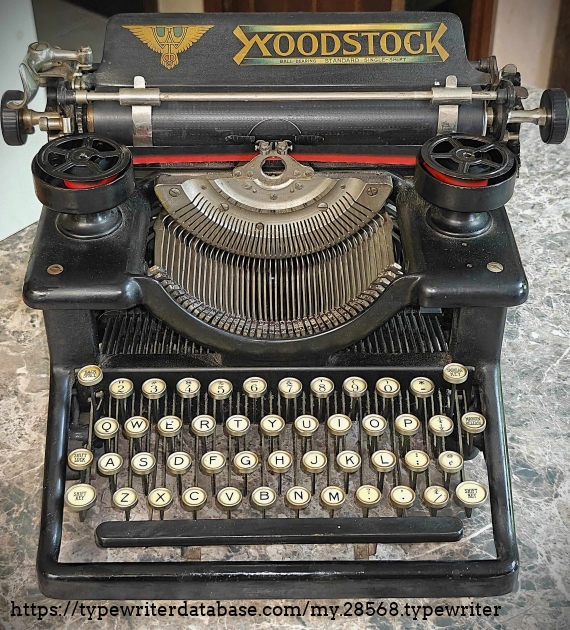
Description:
2026-AUG-08 Update. Glen Crookston has added a new gallery for a Woodstock 4, #265172. There does not seem to be good information about the serial numbers of the early Woodstocks, and TWDB simply says they are "numbered in code". What is the code? I have not found any commentary on that in the articles on Woodstock typewriters by the Davis Brothers. However, I see a pattern that might be more than coincidental from the small number of Model 4's and 4A's on TWDB. So far, there are five galleries for Model 4, and two galleries for Model 4A. Here's the list:
1. # 163527. Owner: Mark Schrad. This has an ostensibly earlier "Woodstock" badge design on the paper table: the "Woodstock" name inscribed in an oblong oval.
2. # 265172. Owner: Glen Crookston. This one also has the Woodstock badge inscribed in an oblong oval on the paper table.
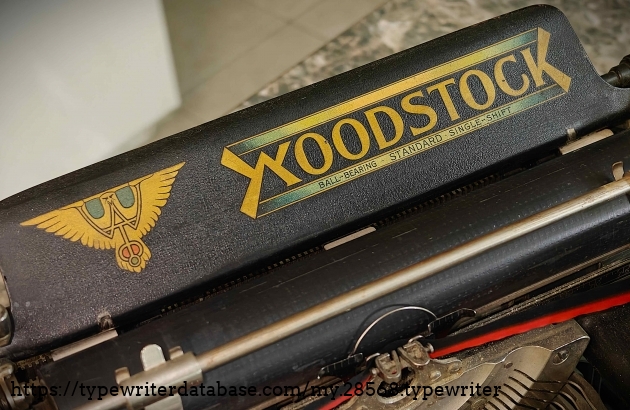
3. # 366042. Owner: Gerald Thompson. This one has the paper table with a bird decal and "Woodstock" in a stylized pattern reminiscent of a Mobius strip.
4. # 468247. Owner: Brian Decker (this gallery). This one also has the bird decal and Mobius strip pattern.
5. # 1462. Owner: Jobers Bersales. This appears to be the earliest Model 4 with a TWDB gallery that has the serial number moved to the milled area on the top right, under the carriage, where it stayed on the Model 5. This example is also notable in that the patent list decal on the back, while worn clean, appears to be the type that includes patent dates through August 1916.
6. # A13998. Owner (presumably): James Grooms. By all appearances, the "A" model showed up around the same time or after the Model 5 started production in late 1916.
7. # A21469. Owner: Glen Crookston.
Unfortunately, the sole Model 3 on TWDB does not have an image showing the serial number. The fact that "6" is the 2nd digit of the serial number for (what appear to be) the four earliest Model 4's on TWDB seems to be no coincidence. It suggests to me that the 2nd digit is possibly a year-code for 1916, and the first digit is perhaps a bi-month code such as Smith-Corona used for the Model 4 portable after the merger of Corona with L. C. Smith. The low serial number for # 1462 perhaps implies that serial numbering was re-started when one of the serial numbers was moved from underneath to the milled surface under the carriage on top. The "A" series perhaps was started around the time that the Model 5 production began, to differentiate an "A" model (Model 4) with a "B" model (Model 5), as the initial series for the Model 5 was the B-series.
Also, the last four digits for the first four serial numbers listed above rise monotonically, to the 8000 range for mine. It seems plausible, in the absence of further evidence in either direction, that these four digits represent a true serial production number. The production estimates for 1917-1919 in TWDB imply a factory production capacity on the order of 10-15k per year, so hitting 8000 in July-August of 1916 is consistent with that level of production capacity.
Just speculating.
2026-JUL-27 Update. Changed the estimated year of manufacture from 1917 to 1916, because it does appear that the patent list and the serial number locations were changed for Model 4’s; see linked gallery.
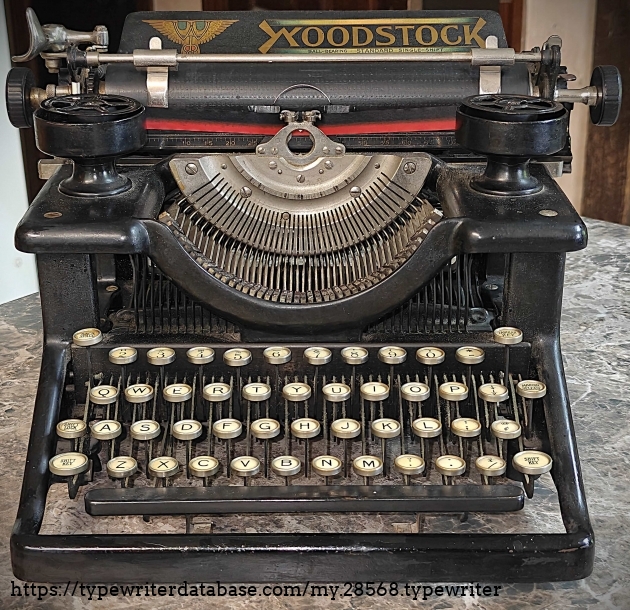
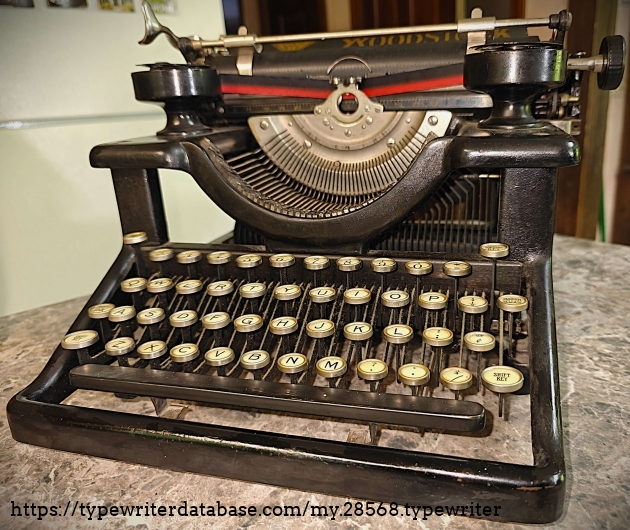
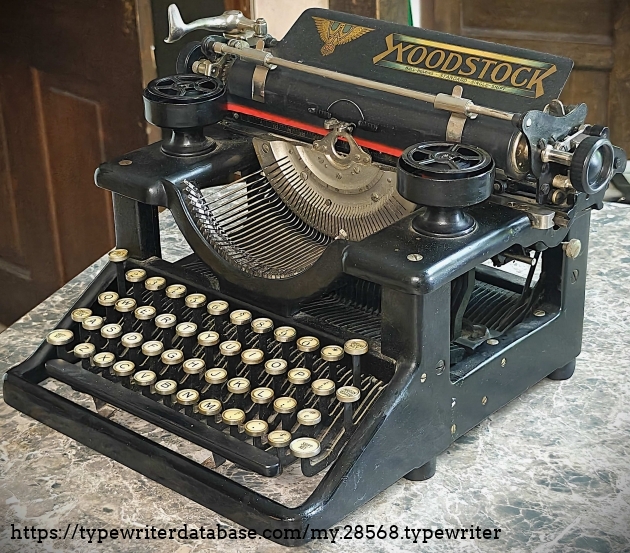
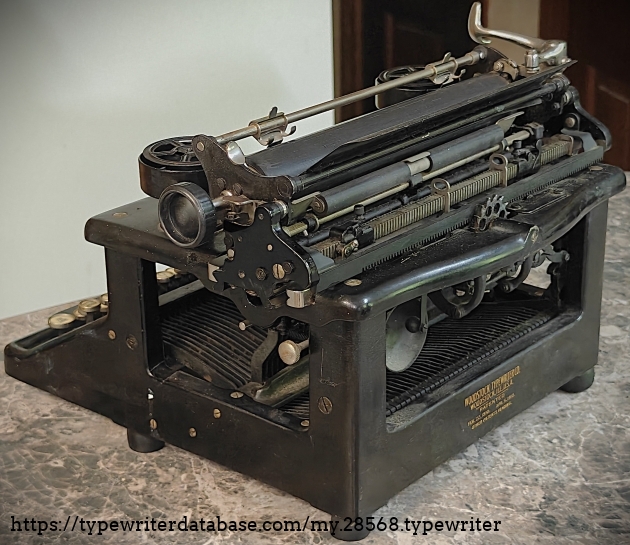
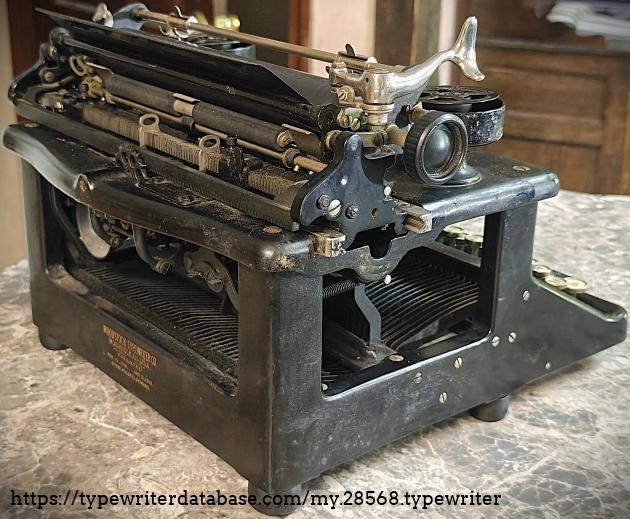
2026-JUL-26, Gallery Creation. This was another eBay find. The seller, based in Lawrence, KS, had it listed as a "1931 Woodstock 5N". I could tell very quickly from the paper table decal that it was unlikely a 5N, and it didn't take long to figure out it wasn't a Model 5 at all. It doesn't have any Model No. badging along the front edge, but it's almost certainly a Model 4. I don't know the key differences between a Model 3 and a Model 4, but the Model 3 is pretty rare, and it's much more likely this is a 4. The seller was asking $139, but extended an offer price of $129 to me, which seemed to me a very good deal for such a scarce machine. Shipping was $38.19 UPS. I provided the seller detailed instructions on careful shipping, which she appreciated, and the machine arrived safely with no damage in transit.
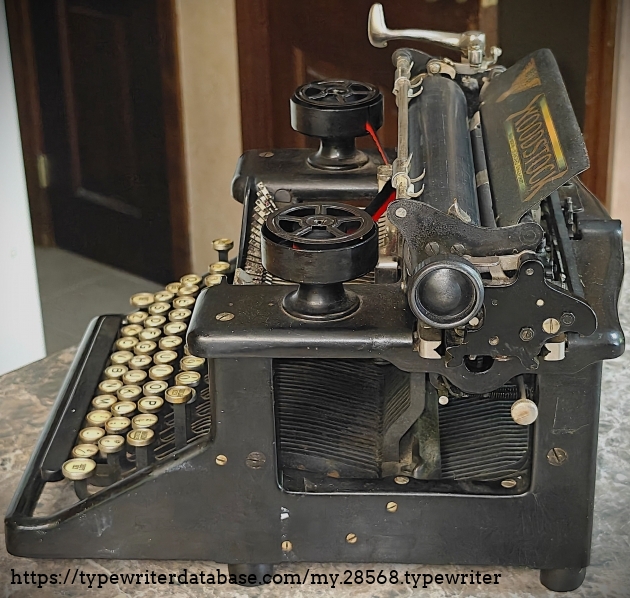
In fact, out of the box, this thing already types very well, with no cleaning or other fussing around so far! I have noticed a fairly large number of subtle (and not so subtle) differences between this machine and my two early Model 5's (linked galleries). Below is a partial list of my observations. I have left off some of the more subtle differences, such as number of screw heads observable on the left and right sides of the machine.
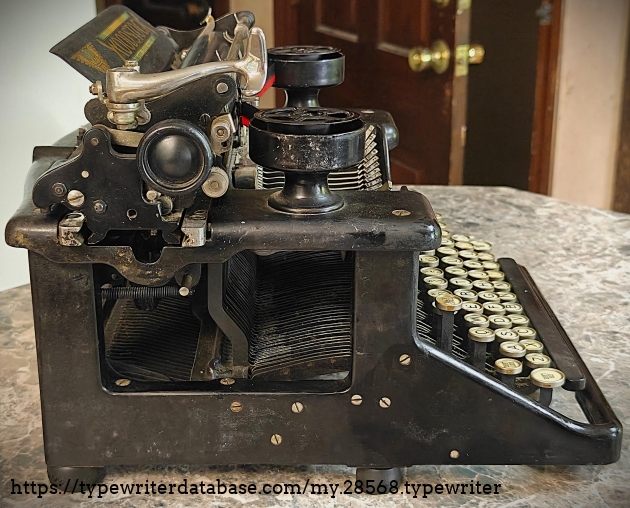
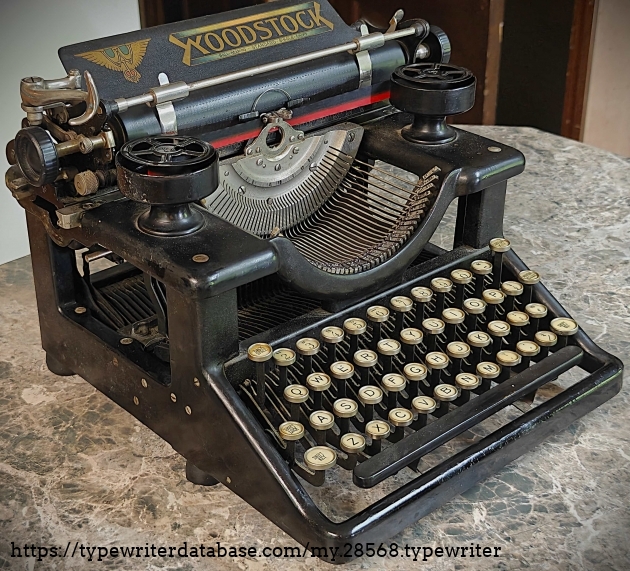
1. Model Number Decal: The "No. 4" badging along the front edge is absent, and looks to me like it was never applied. This may indicate this was a later copy of the No. 4, and they had already rolled out the No. 5, in which case they would not necessarily want to "trumpet" that this was a No. 4. Per the Davis brothers' article (linked gallery), the No. 4 was produced from 1915 (partial year) through the end of 1917. My best guess is this is a 1917 machine, but it could be a 1916 one; I think it's less likely to be a 1915.
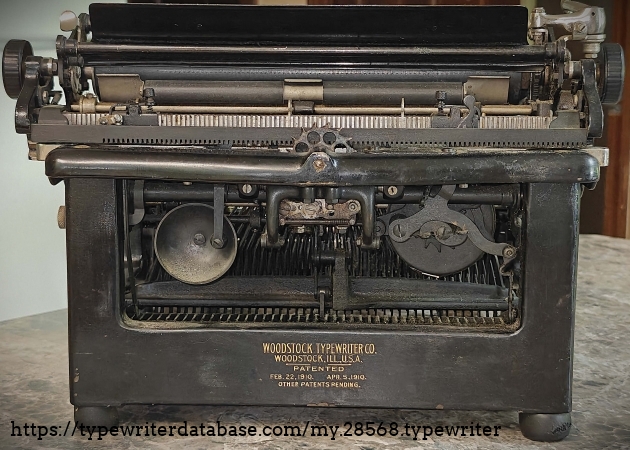
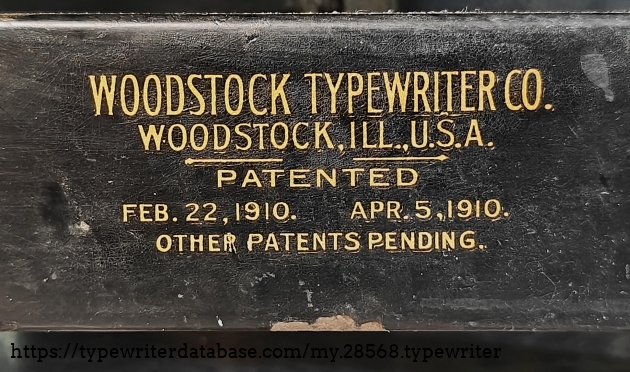
2. Patent Decal. A clear give-away is that this example has the decal on the back showing just the Feb 22 and Apr 5 1910 patent dates. The early Model 5's show patent dates from Feb 22, 1910 through Aug 1, 1916, within a shield or crest motif.
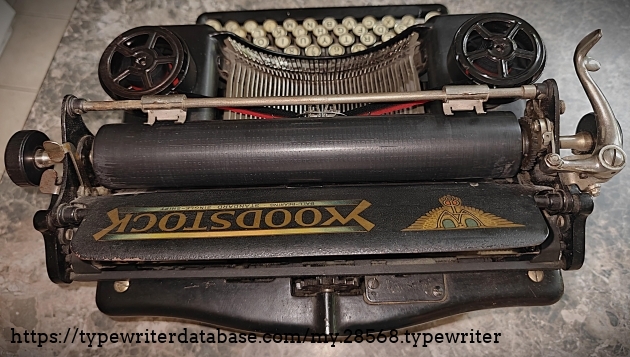
3. Paper Table Decal. This Model 4 has green highlights in the decal artwork on the paper table. Both of my Model 5's have decals in very good condition, and it's clear that the green highlights are replaced by darker, charcoal accents. I am not sure if this was a consistent change going from the earlier models to the Model 5 (I should probably check the galleries on TWDB!).
4. Paper Guide: Absent in the Model 4, present in both of my Model 5's.
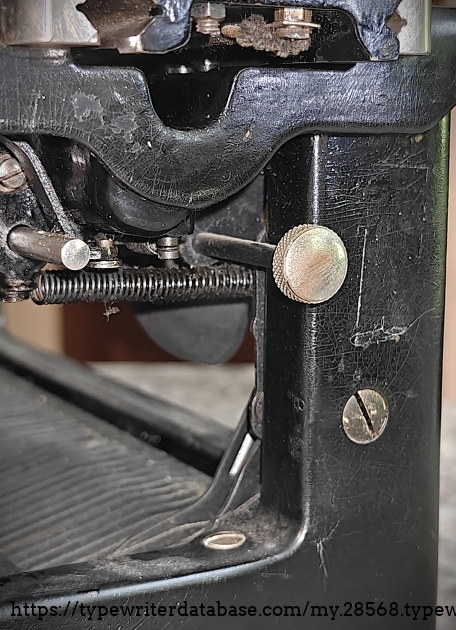
5. Paper Table Supports: The Model 4 paper table rests on a cylindrical rod, whereas the Model 5's have sheet metal fingers that stop the backward motion of the paper table before they reach a square rod with ruler markings.
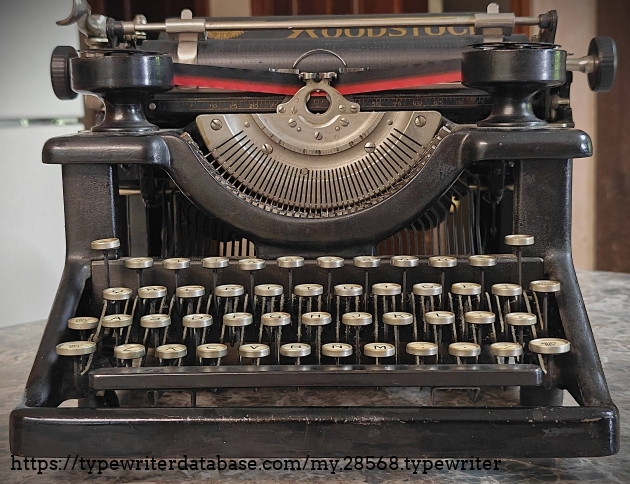
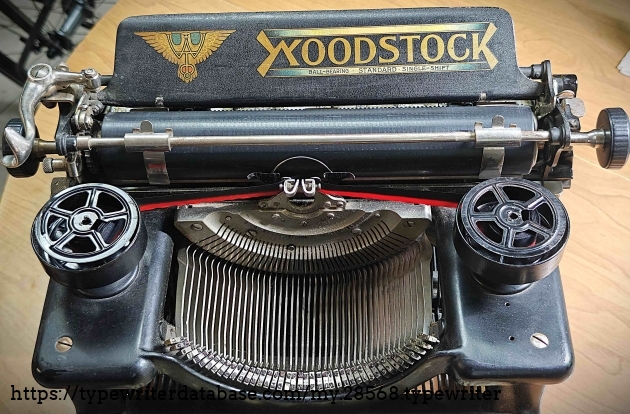
6. Paper Fingers: This is a very obvious and visible difference. The Model 4 has paper fingers without rollers suspended from a horizontal nickeled rod, whereas the Model 5's have paper fingers with rollers, mounted from below. In use, this change does improve visibility for the typed work.
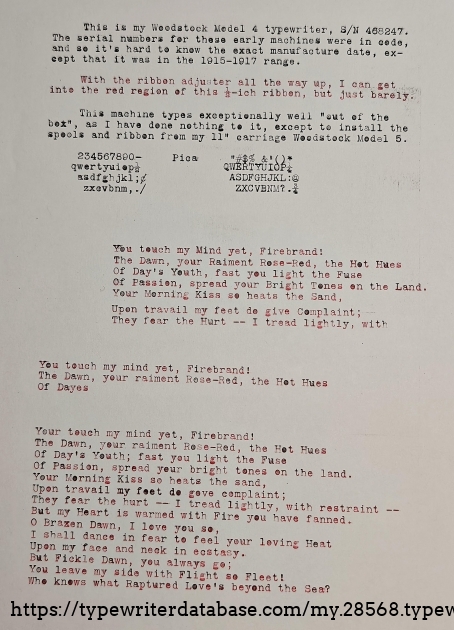
7. Ribbon Selector: Another obvious difference. The Model 4 has a knurled knob on the right-hand side for adjusting the resting height of the ribbon vibrator. This allows one to move to the black or red area of the ribbon, as desired. I believe these early Woodstocks are intended to take 9/16" ribbons. With the much more common 1/2" ribbons, there is a little less real estate to get the ribbon color right. I checked the number of position clicks for the Model 4 and my Model 5's and they are the same: 7 clicks for 8 ribbon vibrator positions.
8. Eraser holder. Normally this would be another obvious difference, but this item is missing from my Model 4. However, it does have the two threaded holes on the top deck at right for mounting one. I wonder if this was left off at the factory? It might imply it was being sold by Woodstock as a Model 4 trying to pass partially as a Model 5.
9. Card guide. I assume that's what the large semi "hoola hoop" structure on the Model 4 is. Neither of my Model 5's has this, although my #B-29702 does have a much smaller ring mounted in front, below the printing point, whose purpose is unclear to me.
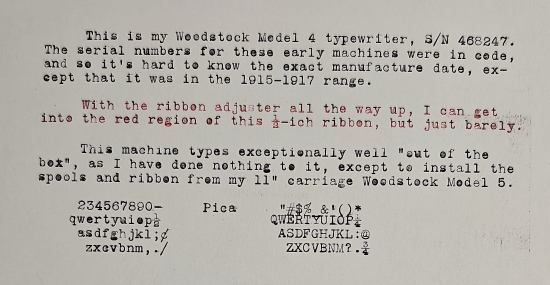
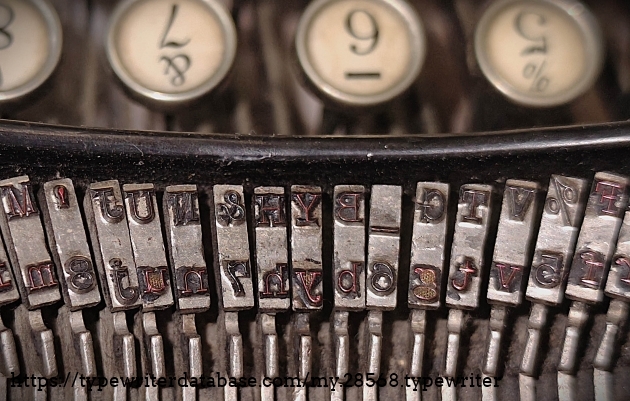
10. Type slugs. My Model 4 has a 10 CPI or Pica typeface, but no foundry marks. Both of my Model 5's have a "1" foundry mark, indicating Pica typeface.
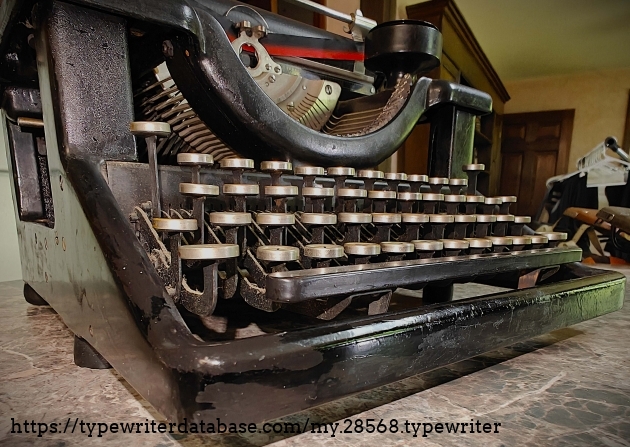
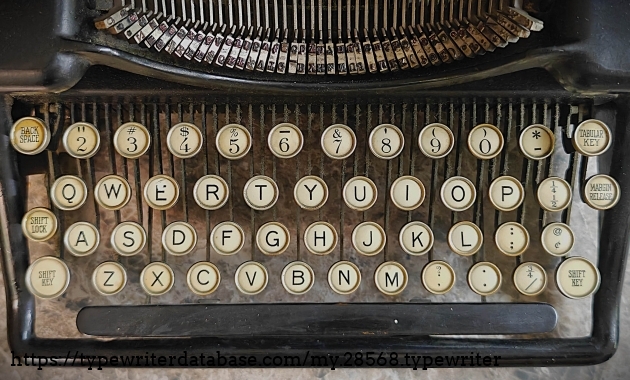
11. Space bar. My Model 4 has a longer space bar, extending past the "z/Z" key to the left, and past the "3/4 / /" key to the right. My Model 5's both have shorter space bars that come about to the center of these keys.
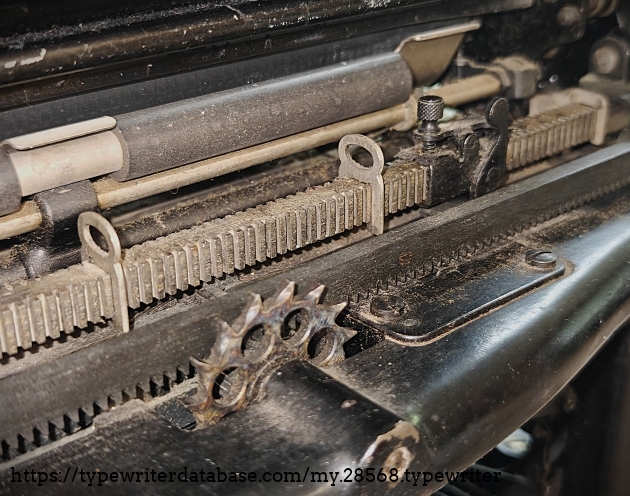
12. Tab stops. My model 4 has adjustable tab stops with much smaller heads than both of my Model 5's.
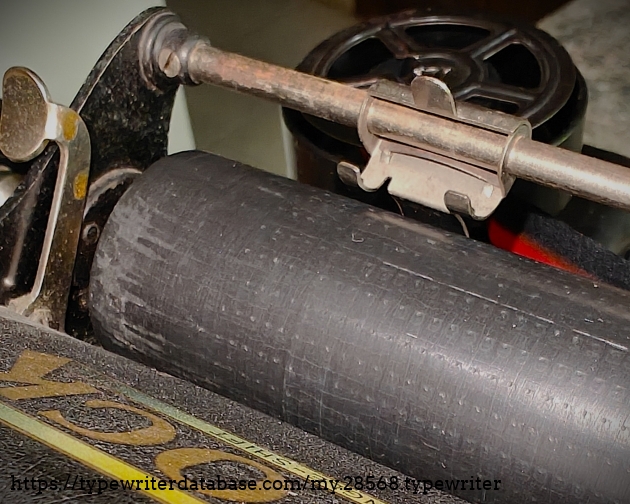
13. Platen knobs. Held by one set screw per knob on the Model 4; held by two set screws per knob on the Model 5's.
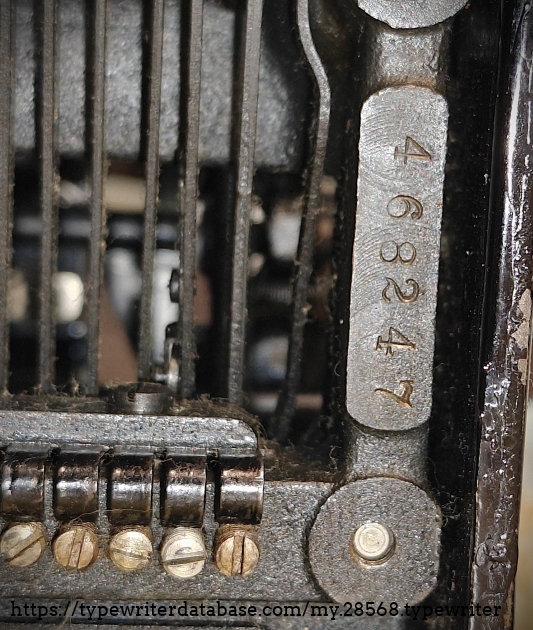
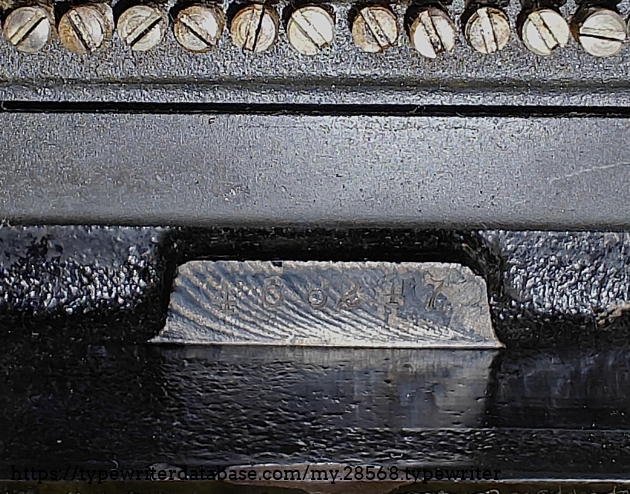
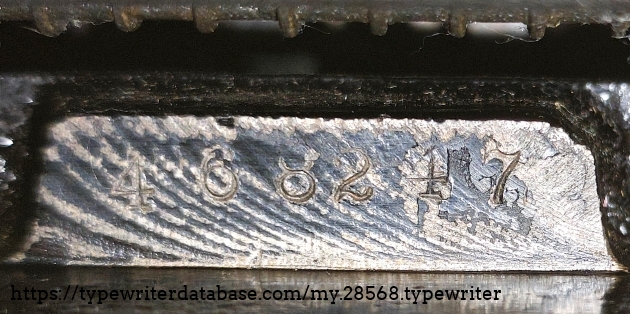
14. Serial numbers. I have not seen any other commentary about serial number locations on these early Woodstocks, and only one serial number is shown (if any) in the galleries currently on TWDB; but my Model 4 has TWO locations for the same stamped serial number, #468247. One is under the machine on the right-hand side, between the right-side feet. The other is on a recessed milled surface that seems to be part of the rear casting of the machine.
Typeface Specimen:
Links:
- Davis Brothers' Blogspot - Introduction to the Woodstock Typewriter
- Gallery for my 1918 Woodstock Model 5, #B-29702
- Gallery for my 1919 Woodstock No. 5, # BW-40431
- Gallery for Woodstock 4 with an updated patent list
Photos:
Hunter: Brian Decker (bkdecker66)
Brian Decker's Typewriter Galleries [ My Collection ] [ My Sightings ]

Status: Typewriter Hunter
Points: 6449
My interest in typewriters started in 1997, when I was in graduate school at the University of Georgia. I purchased and read Darryl Rehr's book, joined ETC, and started reaching out to known collectors. I had several email interchanges with Richard Polt dating from that period. I also bought some of my first machines from Bob Aubert, and visited him at his home twice. After marriage and relocation to New England, I continued visiting antique shops and eBay, until other priorities put my typewriter hobby on hiatus around 2008.
In late 2024, I started up again, working on my machines and having some of them serviced professionally by New England Typewriter (NET) LLC (Merrimack, NH), until they closed their doors in December of 2025. Since mid-2025, I have been adding to my collection again, first with a Hermes 3000 purchase from NET, then with various auctions and purchases on eBay, when I find something that catches my eye.
RESEARCH NOTE: When researching the Woodstock 4 on a computer with lots of screen real estate, you may find that launching the Woodstock Serial Number page and the Woodstock 4 By Model/Year/Serial page in new browser windows can give you interesting perspectives on changes throughout the model series.