
















1073 Brands 3467 Models 25815 Galleries 16351 Typefaces 6273 Patents
Home » Smith Premier » 2 » 1900 #43115
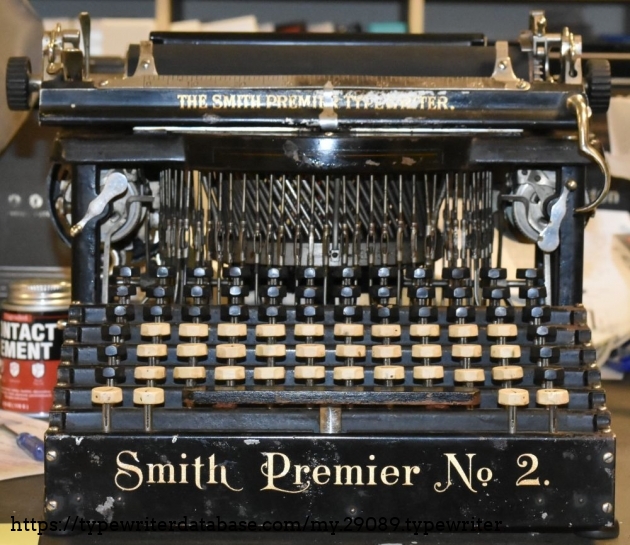
1900 Smith Premier 2 Serial # 43115 1900 Smith Premier 2 typewriter, Serial # 43115 Fumitaka Hayashi's 1900 Smith Premier 2 typewriter. 2026-09-25 From the Virtual Typewriter Collection of Fumitaka Hayashi: 1900 Smith Premier 2 Serial # 43115 A Smith Premier No. 2

My first 19th century machine. It is in not too bad a shape, given its age, but the paint is flaking more than I would like. There is pitting on the chromed parts, as well.

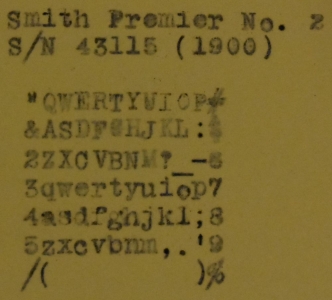
Despite the cosmetic appearance, it is working, and I have been able to provide a type sample.

It's also my first understrike, or blind writer. At least this has the option of flipping the platen up to see the previous line. This also has a built in typeface brush, but it lacks the crank. I wonder if I'll be able to jury-rig something?

There are a few things wrong with it. The line feed pawl is worn, so triple space sometimes double spaces, the double space often single spaces, and the single space does nothing. The bell doesn't always strike. And the platen is hard. However, it's not as hard and cracked like a 126 year old platen should be. I suspect that this platen, as well as the roller, which is in fantastic shape, had been redone in the past 30 years. Which makes sense, as the sellers told me it had come from the son of a collector named Mike Brown, who had written a few books on antique typewriters, and had edited the Typewriter Exchange, a typewriter collector's newsletter that predates ETCetera. I suspect he had redone the rubber on this at one point. Likewise, the feet are ok, though one is cracked. I would have expected them all to be totally gone if they were truly 126 years old.

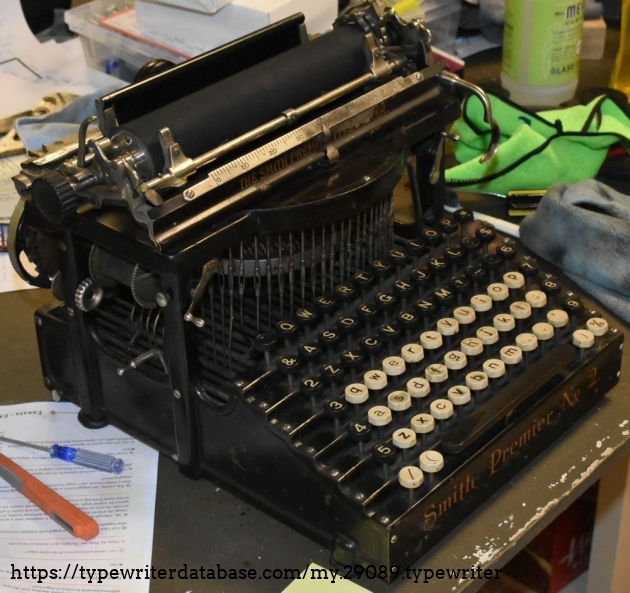
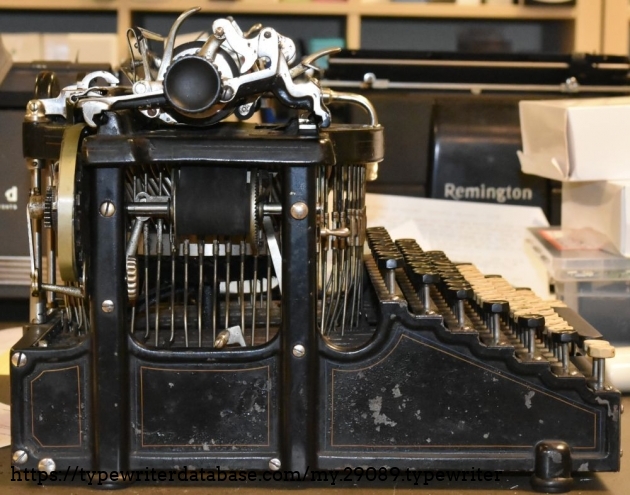
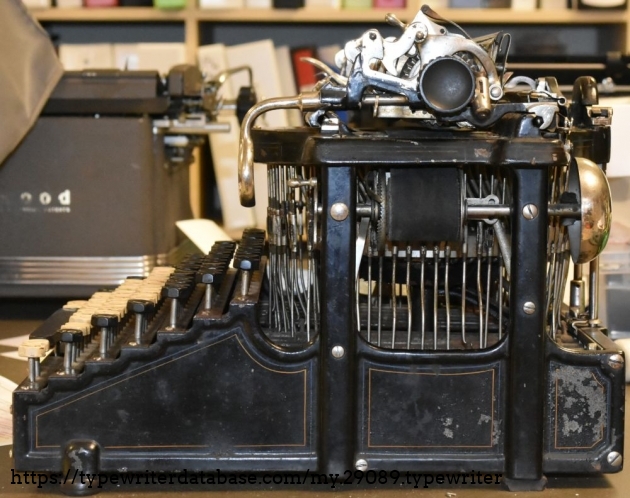
An interesting feature of this design is that nearly all the interesting mechanisms are on the outside, as the inside is dominated by the typebasket, and the underside is taken up by the bulky key mechanism. That leaves the outside perimeter of the mechanism for all the gadgetry. You can see that line lock, and the margin release is obvious. The spring motor and carriage strap are quite odd on this - the spring motor has gearing for the overcomplicated ribbon advance, which also moves laterally, and the strap is a spring steel job - that's not going to break on you.

The controls are not labeled in any way. I figured out that the left side features the ribbon reverse, the cranks on both sides are the ribbon wind, with a pin you pull to pull out the winders for spool removal. There is a small lever on the carriage left which is the margin release. There seems to be no carriage release, and there is no tab or backspace.

It is an interesting design, but clearly inferior to the later visible typewriters.

---
A Facebook Marketplace acquisition, from a nice couple in Feasterville, Pennsylvania - likely originally belonging to collector Mike Brown.

1900 Smith Premier 2 #43115

Status: My Collection
Hunter: Fumitaka Hayashi (fhayashi)
Created: 09-25-2026 at 06:48PM
Last Edit: 09-25-2026 at 07:00PM


Description:

A Smith Premier No. 2

My first 19th century machine. It is in not too bad a shape, given its age, but the paint is flaking more than I would like. There is pitting on the chromed parts, as well.

Despite the cosmetic appearance, it is working, and I have been able to provide a type sample.

It's also my first understrike, or blind writer. At least this has the option of flipping the platen up to see the previous line. This also has a built in typeface brush, but it lacks the crank. I wonder if I'll be able to jury-rig something?

There are a few things wrong with it. The line feed pawl is worn, so triple space sometimes double spaces, the double space often single spaces, and the single space does nothing. The bell doesn't always strike. And the platen is hard. However, it's not as hard and cracked like a 126 year old platen should be. I suspect that this platen, as well as the roller, which is in fantastic shape, had been redone in the past 30 years. Which makes sense, as the sellers told me it had come from the son of a collector named Mike Brown, who had written a few books on antique typewriters, and had edited the Typewriter Exchange, a typewriter collector's newsletter that predates ETCetera. I suspect he had redone the rubber on this at one point. Likewise, the feet are ok, though one is cracked. I would have expected them all to be totally gone if they were truly 126 years old.

An interesting feature of this design is that nearly all the interesting mechanisms are on the outside, as the inside is dominated by the typebasket, and the underside is taken up by the bulky key mechanism. That leaves the outside perimeter of the mechanism for all the gadgetry. You can see that line lock, and the margin release is obvious. The spring motor and carriage strap are quite odd on this - the spring motor has gearing for the overcomplicated ribbon advance, which also moves laterally, and the strap is a spring steel job - that's not going to break on you.

The controls are not labeled in any way. I figured out that the left side features the ribbon reverse, the cranks on both sides are the ribbon wind, with a pin you pull to pull out the winders for spool removal. There is a small lever on the carriage left which is the margin release. There seems to be no carriage release, and there is no tab or backspace.

It is an interesting design, but clearly inferior to the later visible typewriters.

---
A Facebook Marketplace acquisition, from a nice couple in Feasterville, Pennsylvania - likely originally belonging to collector Mike Brown.

Typeface Specimen:
Photos:
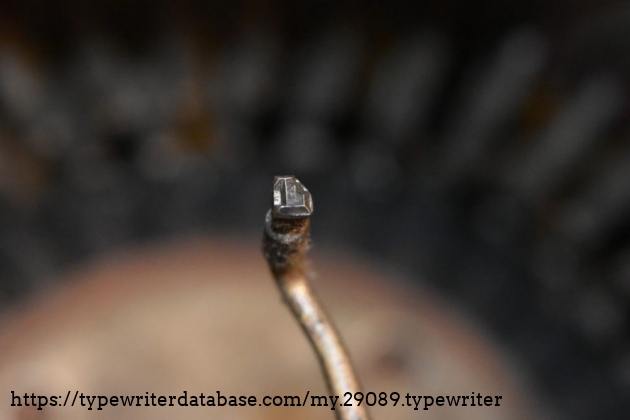
Hilariously small slug - as there is no shifting, each typebar has only one letter, and the slug is only the size of the letter.  I am assuming that alignment is done by 'forming' the typebar.
Hilariously small slug - as there is no shifting, each typebar has only one letter, and the slug is only the size of the letter. I am assuming that alignment is done by 'forming' the typebar.


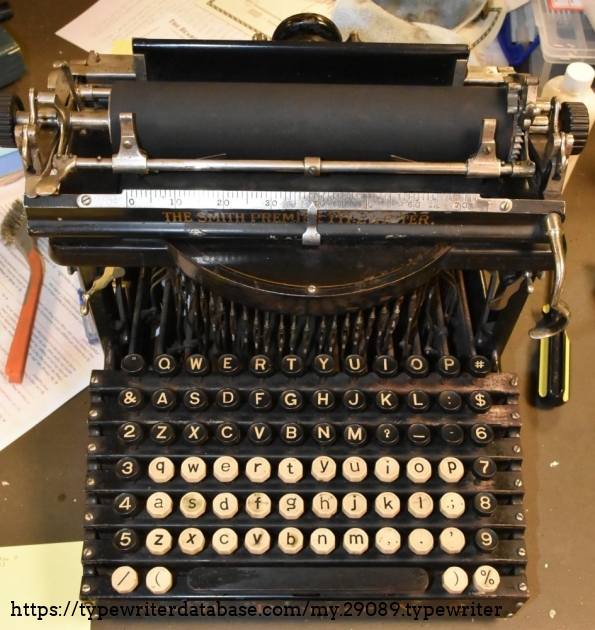
The no-shift, double keyboard was surprisingly easy to get accustomed to.  No ones or zeroes.
The no-shift, double keyboard was surprisingly easy to get accustomed to. No ones or zeroes.


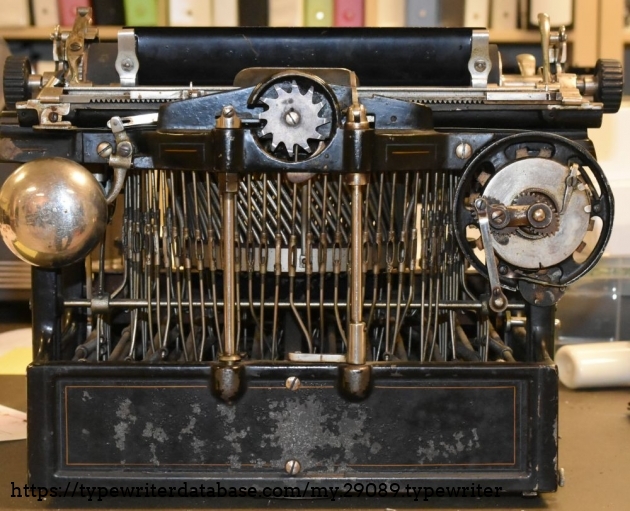
The spring motor is on the right, the bell on the left, and the escapement is top center.  The left center column is the carriage advance, and the right center column is the margin sensor.  Note the small lever on the right column - when the right margin is reached, that lever engages the carriage advance, resulting in the line lock feature which stops you from typing more characters.
The spring motor is on the right, the bell on the left, and the escapement is top center. The left center column is the carriage advance, and the right center column is the margin sensor. Note the small lever on the right column - when the right margin is reached, that lever engages the carriage advance, resulting in the line lock feature which stops you from typing more characters.

The lower half of the typewriter is dominated by the control arms.  Each key is attached to a rod, which rotates to actuate the correct typebar.
The lower half of the typewriter is dominated by the control arms. Each key is attached to a rod, which rotates to actuate the correct typebar.

This is the platen in the normal, typing mode.  This is a blind writer, so you can't see what you just typed, as the slugs hit the paper and the platen from the bottom.
This is the platen in the normal, typing mode. This is a blind writer, so you can't see what you just typed, as the slugs hit the paper and the platen from the bottom.

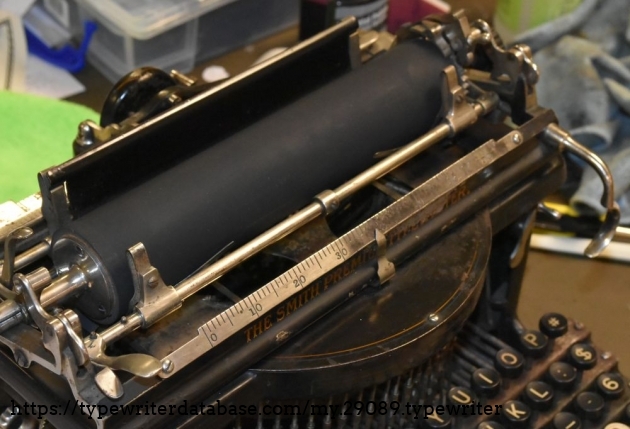
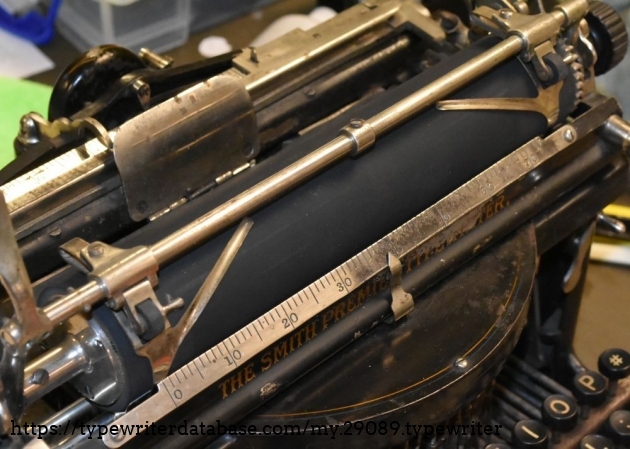
This is the platen on the flipped, viewing mode.  Upon one line advance, the printed line appears right above the ruler.  Note the long paper fingers, which work remarkably well.  It does not work well with index cards.
This is the platen on the flipped, viewing mode. Upon one line advance, the printed line appears right above the ruler. Note the long paper fingers, which work remarkably well. It does not work well with index cards.

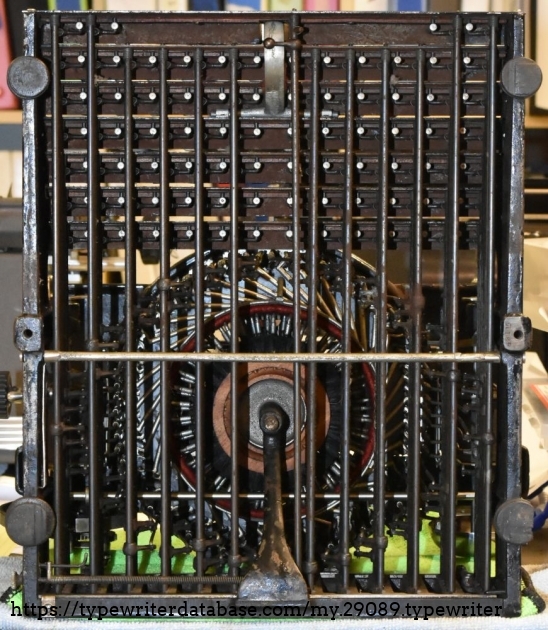
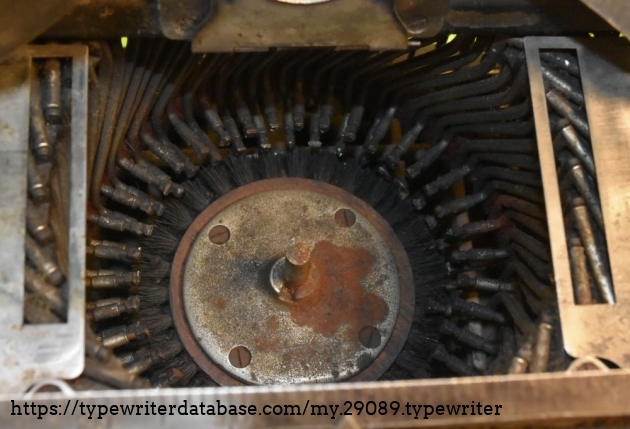
Note the built-in brush in the center of the type basket.  It appears to be on some sort of screw, as it rises as you turn it counter-clockwise.  When fully turned clockwise, the bristles lay below the lower typebars.  I am pretty certain that fully counter-clockwise would cover the upper typebars.
Note the built-in brush in the center of the type basket. It appears to be on some sort of screw, as it rises as you turn it counter-clockwise. When fully turned clockwise, the bristles lay below the lower typebars. I am pretty certain that fully counter-clockwise would cover the upper typebars.

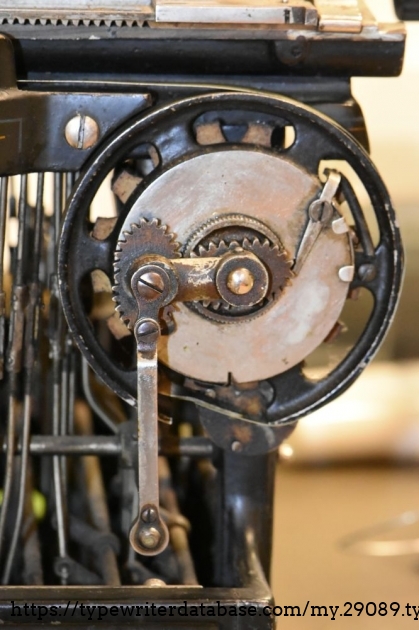
The carriage strap itself appears to be made of spring steel, and the motor is connected to gears to operate the ribbon advance, which also zig-zags laterally.  I'm curious to see how the tri-color variant works - I assume it doesn't zig-zag, and there must be just 3 lanes of colors.
The carriage strap itself appears to be made of spring steel, and the motor is connected to gears to operate the ribbon advance, which also zig-zags laterally. I'm curious to see how the tri-color variant works - I assume it doesn't zig-zag, and there must be just 3 lanes of colors.

Hunter: Fumitaka Hayashi (fhayashi)

Fumitaka Hayashi's Typewriter Galleries [ My Collection ] [ My Sightings ]
Status: Typewriter Hunter
Points: 1379

Trying very hard to be more judicious in my acquisitions...

I like interesting typefaces. I like tinkering with my acquisitions to make them work.


RESEARCH NOTE: When researching the Smith Premier 2 on a computer with lots of screen real estate, you may find that launching the Smith Premier Serial Number page and the Smith Premier 2 By Model/Year/Serial page in new browser windows can give you interesting perspectives on changes throughout the model series.